Dermatologist-led nail care · DehradunWhatsApp appointments ↗
Home › Nail Problems › Periungual Warts
Warts around nails · Nail fold · Dehradun

Rough bumps growing around your nail? They may be periungual warts.

Periungual warts · common skin HPV · treatment near nail matrix

Periungual warts are benign growths caused by common cutaneous human papillomavirus (HPV) types around the nail folds. They can spread with picking or nail biting and may distort the nail if they extend beneath or near the nail matrix. Treatment requires care to avoid damaging normal nail growth.
✓ Caused by common skin-type HPV
✓ May spread with picking or nail biting
✓ Nail-matrix safety is important during removal
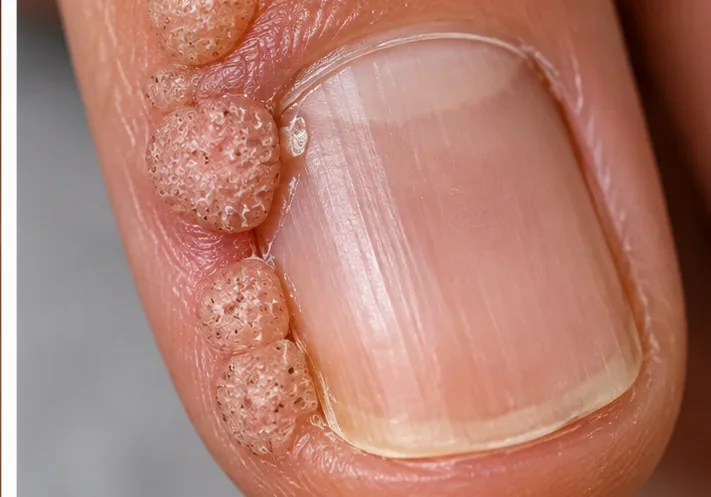
Educational illustration of clustered rough skin-coloured periungual warts along the folds surrounding a fingernail
AI-generated educational illustration · Not a patient photograph or confirmed diagnosis
Appearance

How periungual warts look

Rough raised skin growths

Small grainy bumps or larger clusters around the sides or base of a nail.

Pinpoint black dots

Some warts have tiny black-red dots representing thrombosed capillaries.

Nail distortion

Warts near the matrix or under the plate can cause ridging, lifting or irregular nail growth.

Recurrent or spreading bumps

Several warts may appear on nearby fingers after picking, nail biting or sharing nail tools.

Do not assume every growth is a wart. A persistent, bleeding, ulcerated, rapidly enlarging, heavily pigmented or treatment-resistant single nail lesion should be examined to exclude a tumour, including nail-unit squamous cell carcinoma.
Transmission

Why do warts appear around nails?

  • Common skin HPV infects superficial skin through tiny breaks; these are usually different HPV types from those causing genital warts.
  • Nail biting, picking, repeated trimming injuries and a damaged cuticle help the virus enter and spread.
  • Direct skin contact or contaminated personal nail tools can transmit virus; autoinoculation to other fingers is common.
  • Children and teenagers frequently get ordinary skin warts, but adults can also develop persistent lesions.
  • People with altered immunity may have more extensive or treatment-resistant warts.
Important: A wart around the fingernail does not imply a sexually transmitted infection or sexual exposure.
Diagnosis

How periungual warts are diagnosed

When a wart-like lesion needs another look

Not every growth around or under a nail is a wart. Persistent bleeding, ulceration, rapid enlargement, unusual pigmentation, marked nail destruction or failure to respond to appropriate treatment warrants dermatological reassessment. In selected cases, a carefully planned biopsy is needed to exclude other nail-unit conditions, including squamous cell carcinoma. Do not repeatedly destroy an uncertain lesion without confirming the diagnosis.

1. Examine the growth and nail

A dermatologist evaluates the wart surface, distribution, growth pattern and whether the nail plate is affected.

2. Dermoscopy when useful

Dermoscopy may reveal characteristic vascular dots and help distinguish warts from other growths.

3. Decide when biopsy is needed

Atypical, bleeding, ulcerated, very persistent or suspicious lesions may need biopsy to rule out nail-unit tumours.

4. Choose treatment around the nail matrix

Location matters: aggressive destruction close to the nail matrix may cause lasting nail deformity.

Routine HPV typing and blood investigations are not required for typical periungual warts.

Treatment

Treatment options for warts near nails

01

Observation for selected mild cases

Some warts, particularly in children, clear without treatment. Waiting may be reasonable if small, asymptomatic and not affecting the nail.

02

Carefully applied topical salicylic acid

A clinician may advise a wart-specific keratolytic for a suitable lesion. Protect nearby healthy skin; strong self-applied acids at the nail fold can cause burns and nail injury.

03

Cryotherapy by a trained clinician

Liquid nitrogen is a common option but can cause pain, blistering and pigment changes; repeated sessions may be needed. Extra caution is essential near the nail matrix.

04

Radiofrequency / electrosurgical removal

For selected, accessible warts, radiofrequency/electrosurgical removal under local anaesthesia may be considered. It removes visible wart tissue but does not guarantee elimination of HPV or prevent recurrence. Compared with topical salicylic acid or cryotherapy, it involves a wound and carries risks of pain, infection, scarring and permanent nail deformity if the nail matrix is injured. The best option depends on the wart's size, location, prior treatments and patient preferences; RFA is not universally superior.

05

Options for stubborn or recurrent warts

Warts that persist or recur after appropriately delivered treatment should be reassessed to confirm the diagnosis, check for lesions beneath the nail and review adherence, repeated trauma and immune status when clinically relevant. Treatment may require several sessions or a different approach. Specialists may consider selected intralesional therapies, including immunotherapy or bleomycin, for difficult cases; these are not routine first-line options, and bleomycin near nails can cause pain, vascular injury and nail dystrophy. Referral may be appropriate when the lesion threatens the nail unit or diagnosis is uncertain.

Can warts come back after removal?

Yes. Treatment removes visible wart tissue but cannot guarantee elimination of HPV from surrounding skin. More than one session may be needed and recurrence is possible.

Aftercare & prevention

Reduce wart spread and protect nail growth

  • Avoid biting nails, pulling cuticles, shaving or picking affected skin.
  • Do not share nail clippers, files, manicure tools or wart-treatment instruments.
  • Keep any treatment site clean and follow the clinician’s dressing advice after a procedure.
  • Do not use high-strength acids, blades or home freezing kits around the cuticle without professional guidance.
  • Return for a growing, bleeding, painful or treatment-resistant nail-unit growth.

Periungual warts are different from paronychia (inflammation of the nail fold) and nail fungus.

Patient questions

Frequently asked questions

Are periungual warts sexually transmitted?
They are usually caused by common skin HPV types and do not, on their own, indicate a sexually transmitted infection.
Can a wart permanently damage a nail?
Yes. A wart involving the nail matrix, or overly aggressive treatment at that location, can result in persistent nail dystrophy.
Will one radiofrequency session cure every wart?
No. Selected warts may be removed at a session, but residual wart tissue or HPV can lead to recurrence.
Should I use wart-remover acid around the cuticle?
Strong chemicals can injure surrounding skin and nail matrix. Ask a dermatologist to confirm the diagnosis and appropriate application before treating periungual lesions.
Can nail biting spread warts?
Yes. Biting and picking create skin breaks and can transfer virus to nearby digits.
Does every periungual wart need treatment?
No. Some small, uncomplicated warts, especially in children, resolve spontaneously. Pain, spread, nail distortion or patient preference may favour treatment.
Could a growth that looks like a wart be something serious?
Occasionally. A persistently bleeding, ulcerating, growing or atypical nail lesion needs examination and sometimes biopsy.
Do periungual warts come back after removal?
Yes. Recurrence is possible after any treatment because visible wart removal does not always eliminate HPV-infected tissue. Follow-up is useful if a lesion returns.
Can wart treatment permanently damage my nail?
Aggressive freezing, cautery or other destructive treatment close to the nail matrix can cause permanent ridging, splitting or deformity. Treatment should be planned according to the wart's exact location.
Is radiofrequency better than freezing for nail warts?
Not always. Radiofrequency, cryotherapy and topical treatments have different advantages and risks. There is no single best treatment for every periungual wart.
Can I cut or burn a wart around my nail at home?
No. Cutting, burning or using strong acids without guidance can cause infection, scarring and nail damage. Ask a dermatologist about safe treatment.
When should a wart-like growth be biopsied?
A persistent, atypical, ulcerating or repeatedly bleeding growth, or one that fails appropriate treatment, may require biopsy after specialist assessment to rule out other conditions.
Medical information, not an individual prescription.

Investigations and treatment are chosen after a clinical examination. Do not start medicines or attempt procedures based only on this page. Images are AI-generated educational illustrations, not clinical patient photographs or treatment results.

Start with the right diagnosis.

Dr Neeraj Garg · MBBS (IMS-BHU), MD (IMS-BHU)
Maheshwari Hospital, Dalanwala, Dehradun · Consultation ₹800

WhatsApp appointment ↗
Call ClinicWhatsApp ↗