Prescription topical nail treatments
Nail lacquers or solutions may be appropriate for selected mild, limited infections, but they require prolonged and regular use. Ordinary skin creams are usually insufficient for infected nail plates.
A fungal nail infection (onychomycosis) can make a nail yellow, white, thick, brittle or separated from the nail bed. Psoriasis, injury and other nail disorders can look similar. Correct diagnosis matters before treatment, especially before starting oral antifungal tablets.
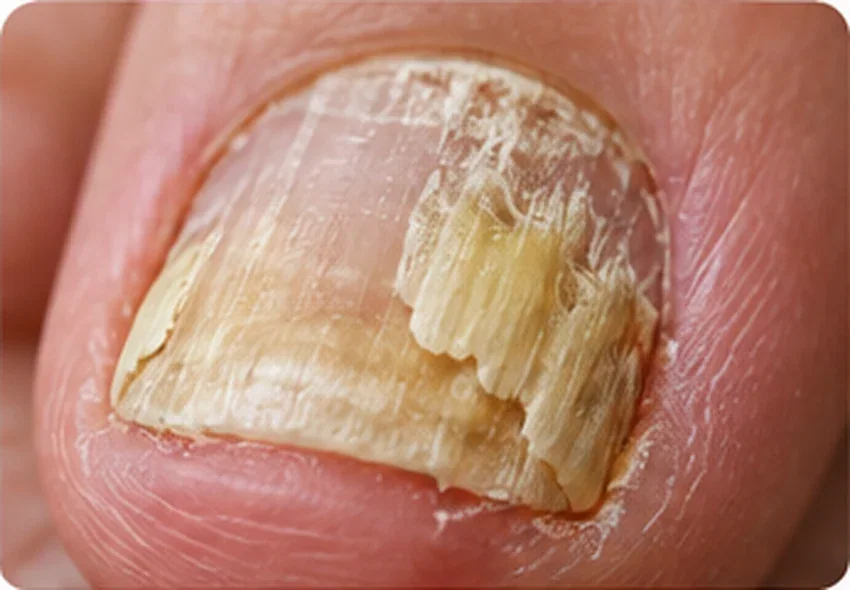
White, yellow or brown discolouration affecting part or all of a nail.
Thick, crumbly nail edges, subungual buildup and difficulty trimming the nail.
The nail may lift (onycholysis), leaving a gap where debris collects.
Toenails are often affected; athlete’s foot may occur alongside it.
Important: A yellow nail is not automatically a fungal infection. Nail psoriasis, lichen planus, repeated shoe trauma and other causes of dystrophy must be considered.
Dermatophytes are the most common cause; yeasts and non-dermatophyte moulds may also be involved. Fungal spores can spread in moist environments, but contact does not mean everyone becomes infected.
Examination and the pattern of nail involvement guide which tests are useful. For a suspected fungal nail needing oral therapy, it is important to confirm fungal infection rather than diagnose by appearance alone.
Check nail colour, thickness, lifting, pressure injury and signs of nail psoriasis or other conditions.
Clippings or scrapings are taken from the most informative affected region when possible.
KOH microscopy, fungal culture, PAS staining of nail clippings or other available tests may be considered. A negative test can need reassessment if suspicion remains high.
Identification of a causative organism may be especially useful with atypical infection, prior treatment failure or suspected non-dermatophyte mould disease.
Nail lacquers or solutions may be appropriate for selected mild, limited infections, but they require prolonged and regular use. Ordinary skin creams are usually insufficient for infected nail plates.
For confirmed and suitable cases with more extensive nail involvement, an oral medicine such as terbinafine may be considered after reviewing liver health, medication interactions and contraindications. Common adult courses are about 6 weeks for fingernails and 12 weeks for toenails; the actual regimen is individualized.
Careful nail thinning and trimming may improve comfort and can assist selected treatment plans. Nail removal is not routinely needed for every fungal nail.
Manage fungal infection on the feet, keep feet dry and avoid sharing nail tools to lower the chance of reinfection.
A toenail can require 12–18 months or longer to grow out. Persistent visible discolouration immediately after a treatment course does not by itself prove failure.
Clearing the fungus and growing a healthy-looking nail are not always the same thing. Dermatologists assess improvement in different ways.
Fungal tests become negative after treatment. This means the infection has cleared by the laboratory criteria used.
The nail has grown out looking normal or nearly normal, according to the clinical criteria being used.
Both laboratory fungal clearance and clinical clearance are achieved. Complete cure is harder to achieve than improvement alone.
Healthy nail grows from the base, while the older, damaged nail gradually moves towards the tip. Toenails often need 12–18 months or longer to replace the affected nail.
Yes. Studies commonly report recurrence in approximately 20–25% of cases, although rates vary considerably with the population, treatment and follow-up period. Recurrence may reflect a relapse or a new infection. Treating athlete’s foot, keeping footwear and nail tools clean and recognising new changes early can reduce the chance of another episode. This percentage is a research estimate, not a prediction for an individual patient.
Persistent discolouration after a course of treatment does not automatically mean treatment failure: the old abnormal nail may simply be growing out. But persistent or newly spreading changes deserve reassessment.
Nail psoriasis, repeated trauma and other disorders may resemble fungal infection. The initial diagnosis or specimen may need review.
Very thick nails, extensive involvement, a fungal mass (dermatophytoma), incorrect application or missed doses may reduce success.
Untreated athlete’s foot, damp footwear, shared or inadequately cleaned nail tools and ongoing nail trauma can contribute to recurrence.
Yeasts, non-dermatophyte moulds or less-susceptible dermatophytes may respond differently. Antifungal resistance is one possibility, but not the explanation for every failure.
A dermatologist may review the previous treatment, examine nail growth and nearby skin, and repeat appropriate sampling (such as microscopy, culture or nail-clipping histology) when indicated. Treatment is then adjusted to the confirmed findings rather than automatically repeating oral antifungal tablets.
If symptoms recur, the diagnosis and original laboratory findings may need to be reviewed before another course is prescribed.
Treatment and investigation choices vary with the findings at examination. Do not start or stop medicines or attempt a nail procedure based on this page. The nail image is AI-generated for illustration and cannot identify a disease by itself.
Dr Neeraj Garg · MBBS (IMS-BHU), MD (IMS-BHU)
Maheshwari Hospital, Dalanwala, Dehradun · Consultation ₹800