Acute urticaria
Hives occurring for less than six weeks. Viral illnesses, medicines and, sometimes, a true allergic reaction may be involved.
Itchy raised patches that appear, disappear and return?
Get a clear assessment of recurring hives and swelling. Treatment focuses on controlling symptoms, recognising important triggers and avoiding unnecessary allergy tests.
Consultation ₹800 · Maheshwari Hospital, Dalanwala, Dehradun
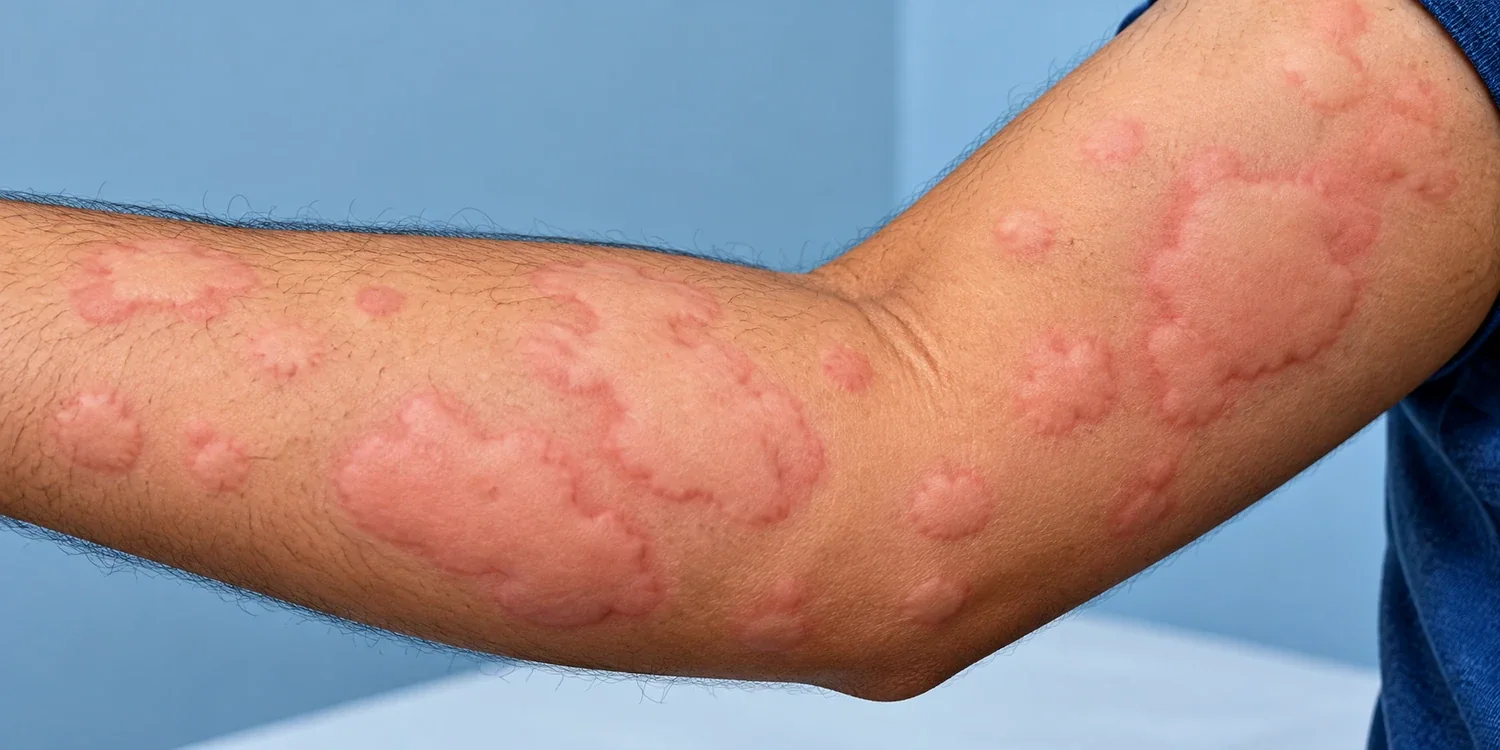 Raised, itchy wheals · Usually transient
AI-generated medical illustration for education; not a photograph of a patient.
Urticaria causes raised, itchy skin swellings called wheals, often triggered by release of histamine and other mediators from skin mast cells. Each individual wheal typically fades within 24 hours, although new ones may appear elsewhere. Hives are not contagious and do not always mean food allergy.
MBBS (IMS-BHU), MD (IMS-BHU)
Dermatologist & Venereologist · Dehradun
Dr Neeraj Garg completed both MBBS and MD at the Institute of Medical Sciences, Banaras Hindu University (IMS-BHU). He provides evidence-based assessment for skin, hair, nail and sexually transmitted conditions, with individualised care, clear counselling and patient privacy.
 MBBS + MDBoth from IMS-BHU
The timing of the rash and what brings it on often tell the dermatologist more than a long list of allergy tests.
Hives occurring for less than six weeks. Viral illnesses, medicines and, sometimes, a true allergic reaction may be involved.
Recurrent wheals, swelling or both for six weeks or longer, often with no consistent outside trigger.
May follow scratching, pressure, cold, heat, vibration or body warming. The pattern guides any provocation testing.
Deeper swelling may affect lips, eyelids or other areas. Isolated or recurrent swelling sometimes needs a different evaluation.
If hives or swelling occur with breathing difficulty, throat or tongue swelling, fainting or collapse, seek emergency care immediately. Suspected anaphylaxis needs prompt emergency treatment, including intramuscular adrenaline when indicated; antihistamines alone are not sufficient.
Chronic spontaneous urticaria involves recurring activation of skin mast cells and may have an autoimmune basis. It is usually not caused by an undetected food allergy.
Skin mast cells release substances that cause temporary swelling and itching. The precise reason may not be identifiable in every patient.
In susceptible patients, overheating, rubbing, tight clothing or medicines such as some painkillers (NSAIDs) may worsen hives.
A broad food allergy panel is generally unhelpful for chronic spontaneous urticaria without a convincing immediate-reaction history.
Most hives are not dangerous, but some patterns deserve prompt review or a different diagnosis.
Wheals or swelling that recur for six weeks or longer, disrupt sleep or require frequent medication deserve a structured assessment and control plan.
Individual lesions that persist, bruise or leave discolouration may suggest another diagnosis such as urticarial vasculitis.
Recurrent lip or facial swelling, especially without wheals, may need a separate assessment for other forms of angioedema.
Not all angioedema is caused by the same mechanism. The symptoms, medicines being taken and family history help guide assessment.
May accompany itchy hives, but can also occur alone. It often improves with appropriate antihistamine treatment.
Recurrent swelling without wheals may warrant a medication review (especially ACE inhibitors) and, in selected cases, C4 and C1-inhibitor testing for bradykinin-mediated angioedema. These forms may not respond to antihistamines.
Emergency: Tongue or throat swelling, difficulty breathing or faintness requires immediate emergency care, even when no hives are visible.
The aim is to identify the pattern, recognise danger signs, choose appropriate investigations and build a practical treatment plan.
Discuss duration of each wheal, recurrence, swelling, medicines, possible triggers and any accompanying illness. Photos help when the skin looks normal at the visit.
Distinguish acute, chronic spontaneous and inducible urticaria; consider other diagnoses for atypical or persistent lesions.
Investigations may be limited or guided by history and examination. Specific provocation or blood tests are used selectively.
Choose regular treatment when appropriate and review symptom control, side effects and the need to adjust the plan.
Tests depend on the type of urticaria and the history; broad panels are not routinely needed.
Routine blood or allergy testing is usually unnecessary. Tests are considered if the history suggests a specific cause or another diagnosis.
A limited baseline evaluation commonly includes a complete blood count with differential and ESR and/or CRP. The history and examination guide any additional testing.
In specialist care, total IgE and IgG anti-thyroid peroxidase (anti-TPO) antibodies may help characterise some chronic cases. Further tests are selected according to the findings, not ordered as a broad allergy package.
Carefully selected provocation or threshold testing may help confirm triggers such as cold, pressure or dermographism. Testing should be clinician-directed.
The appropriate choice depends on the diagnosis, age, symptoms, medical history and previous treatment response. These are treatment categories, not a self-medication plan.
Non-sedating or less-sedating H1 antihistamines are the usual first-line treatment. For chronic urticaria, regular use is often more helpful than repeatedly waiting for a flare.
When standard dosing is insufficient, guidelines allow a clinician to increase a suitable second-generation H1 antihistamine up to fourfold in selected patients. This is usually off-label and must be medically supervised.
Omalizumab may be considered when adequately optimised antihistamines do not control chronic spontaneous urticaria. Suitability, access and monitoring need individual discussion.
For severe refractory cases, clinicians may consider other options, such as ciclosporin with appropriate safety monitoring. These are not routine treatments for everyone.
Systemic corticosteroids are not recommended for long-term control of chronic urticaria. A short course may sometimes be considered for a severe flare after medical assessment, but ongoing control generally requires another plan.
Try to identify reproducible aggravating factors, but avoid making major lifestyle changes based on guesswork.
Individual wheals may disappear before your appointment. A photo with the time noted can help the diagnosis.
Heat, hot showers or sweating aggravate symptoms for some patients; cooler surroundings may reduce discomfort.
Scratching, tight clothing or heavy straps can worsen certain inducible types.
Tell your dermatologist about painkillers and other medicines. Do not stop prescribed medicines without advice.
Frequency, itching, swelling and sleep disturbance can help track control; the Urticaria Control Test may be used.
Routine restrictive diets and broad allergy testing are usually unnecessary without a clear clinical reason.
No. Urticaria itself does not spread through touch, towels, clothes or shared meals.
Hives, angioedema or both that recur for six weeks or longer meet the time definition of chronic urticaria.
Usually not. A true food allergy is considered when symptoms follow a specific exposure promptly and repeatedly, particularly with other allergic symptoms.
Not routinely. Testing should be targeted to the medical history. Broad panels often create confusing results without improving care.
Individual hives typically fade within 24 hours, while new wheals can arise elsewhere as mast-cell activity continues.
Stress may worsen symptoms for some patients, but it is not an adequate explanation for every case and does not replace medical assessment.
Many modern second-generation antihistamines are used long term under a clinician’s guidance. The choice and dose depend on age, other medicines and medical conditions.
No. Some guidelines allow up to fourfold dosing of a suitable second-generation antihistamine for selected chronic cases, but this is off-label and should only be done under medical supervision.
No. Repeated or prolonged systemic steroid use is not advised for chronic urticaria due to adverse effects. Discuss a safer long-term control plan.
Wheals are superficial raised itchy patches; angioedema is deeper swelling. Recurrent angioedema without wheals sometimes needs a different work-up.
Painful lesions persisting over 24 hours, especially with bruising or residual pigmentation, require assessment for other conditions such as urticarial vasculitis.
Tongue or throat swelling, breathing difficulty, wheezing, faintness or collapse require urgent emergency evaluation because anaphylaxis or airway compromise may be occurring.
Dr Neeraj Garg · MBBS (IMS-BHU), MD (IMS-BHU) · Maheshwari Hospital, Dalanwala, Dehradun. Consultation ₹800 · Appointment booking advised.
Medical information is educational. Images are AI-generated illustrations; they do not replace a clinical diagnosis.