Sudden shedding
More hair than usual on your pillow, brush or during washing.
Telogen effluvium is a common cause of widespread, non-scarring hair shedding. It often begins two to four months after a trigger such as fever, childbirth, surgery, major stress or rapid weight loss. Many cases recover once the trigger resolves, although prolonged or recurrent shedding needs assessment to look for ongoing triggers or coexisting hair disorders.
Consultation ₹800 · Pre-booking required · No advance booking payment
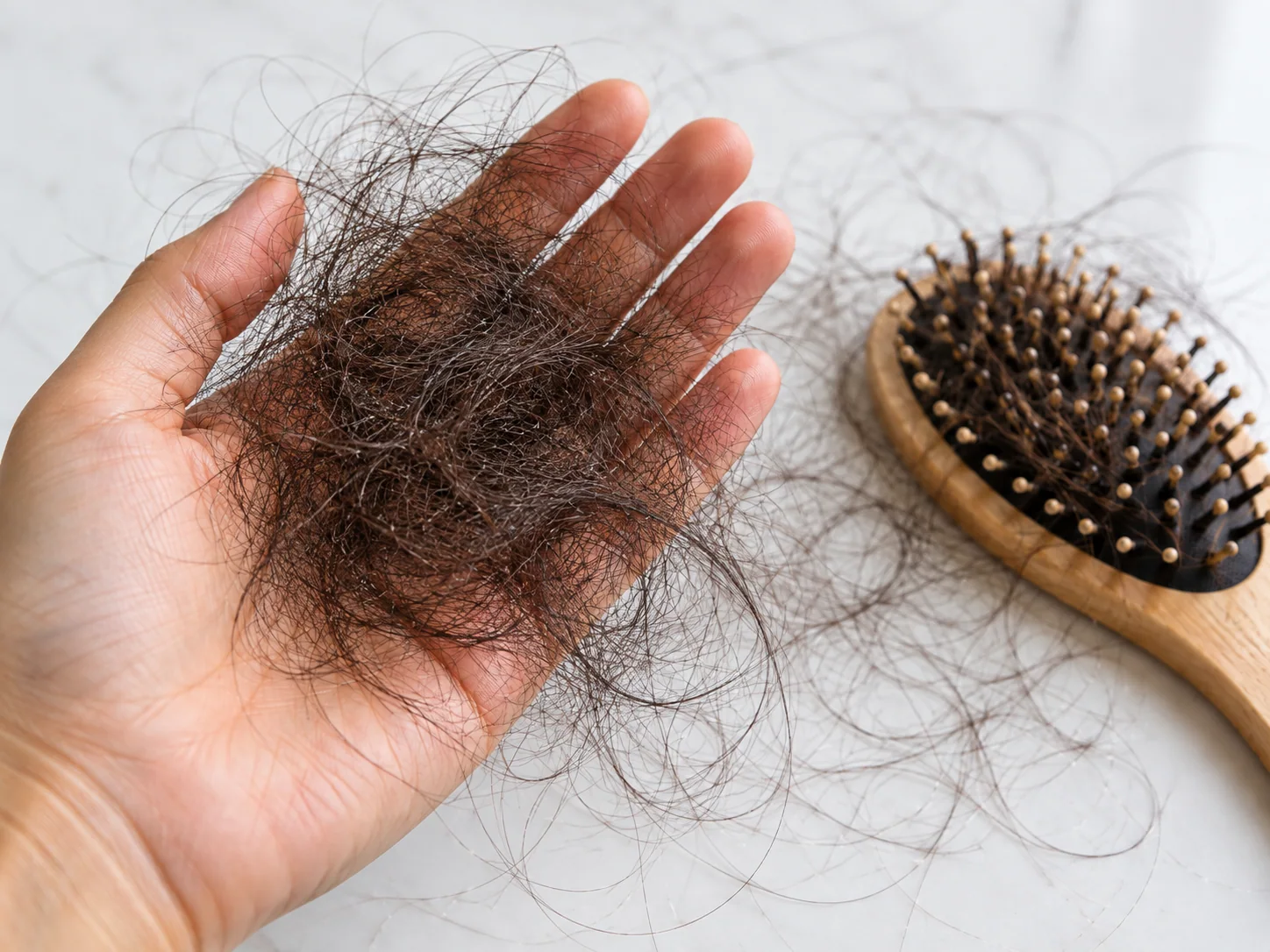
These clues help distinguish one kind of hair loss from another—but images and symptoms alone cannot confirm a diagnosis.
More hair than usual on your pillow, brush or during washing.
Shedding is diffuse rather than limited to a round bald patch.
Illness, childbirth or a major dietary change months earlier.
Short new hairs may emerge while older resting hairs shed.
Hair follicles cycle between growing, resting and shedding phases. A major physiological stress can shift more follicles into the resting phase; those hairs fall out later, commonly after a two-to-four-month delay.
Triggers include significant fever, medical illness, childbirth, crash dieting, iron deficiency, certain medicines, thyroid disorders and major physical or psychological stress. Not every stressful day causes telogen effluvium, and a trigger is not always identified. It can coexist with female or male pattern hair loss.
Clinical history and scalp examination guide whether trichoscopy, laboratory tests, microscopy or biopsy is needed. Not every patient requires all investigations.
Review illness, delivery, nutritional changes, medicines and weight change in the preceding months.
Look for diffuse shedding with preserved follicular openings; consider a hair-pull test and trichoscopy to distinguish pattern loss.
Blood count, ferritin/iron assessment, TSH or other tests may be appropriate when history or examination suggests deficiency or systemic disease; not every patient needs a large panel.
Management depends on the actual condition, its severity, age, medical history and your goals. Procedures are not a replacement for treating the underlying cause.
Treat documented deficiencies, manage thyroid or other medical disease, and restore adequate protein and energy intake where needed.
Acute telogen effluvium often improves over months, but hair density takes longer to recover because new hairs grow slowly. Reassurance is useful only after confirming the diagnosis.
Normal gentle washing, avoiding tight hairstyles and minimising heat/chemical trauma can reduce additional breakage; washing does not cause the resting hairs to shed.
If shedding persists beyond six months, repeats or unmasks androgenetic alopecia, reassess the diagnosis. Minoxidil may be considered in selected chronic or coexisting-pattern cases; PRP/GFC is not routine first-line care for uncomplicated acute telogen effluvium.
Hair grows slowly. These are broad clinical milestones, not a guaranteed timetable for recovery or response.
Excessive shedding commonly becomes noticeable.
Many acute episodes begin improving after the trigger resolves.
Fuller density may return gradually; persistent loss deserves review.
Clear answers without unrealistic promises or one-size-fits-all treatments.
Do not begin or discontinue prescription treatments solely from a webpage. A dermatologist can identify overlapping disorders and discuss benefits, contraindications and follow-up. All clinical images on this page are AI-generated illustrations—not photographs of patients or treatment results.
Dr Neeraj Garg · MBBS (IMS-BHU), MD (IMS-BHU)
Maheshwari Hospital, Dalanwala, Dehradun · Consultation ₹800